What I Talk Clients Out of Building (and Why It Saves Them Money)
A good developer tells you what not to build. Here are the features I most often talk clients out of at launch, from native apps to loyalty systems, the three questions I ask before building anything, and why "not now" isn't "no".
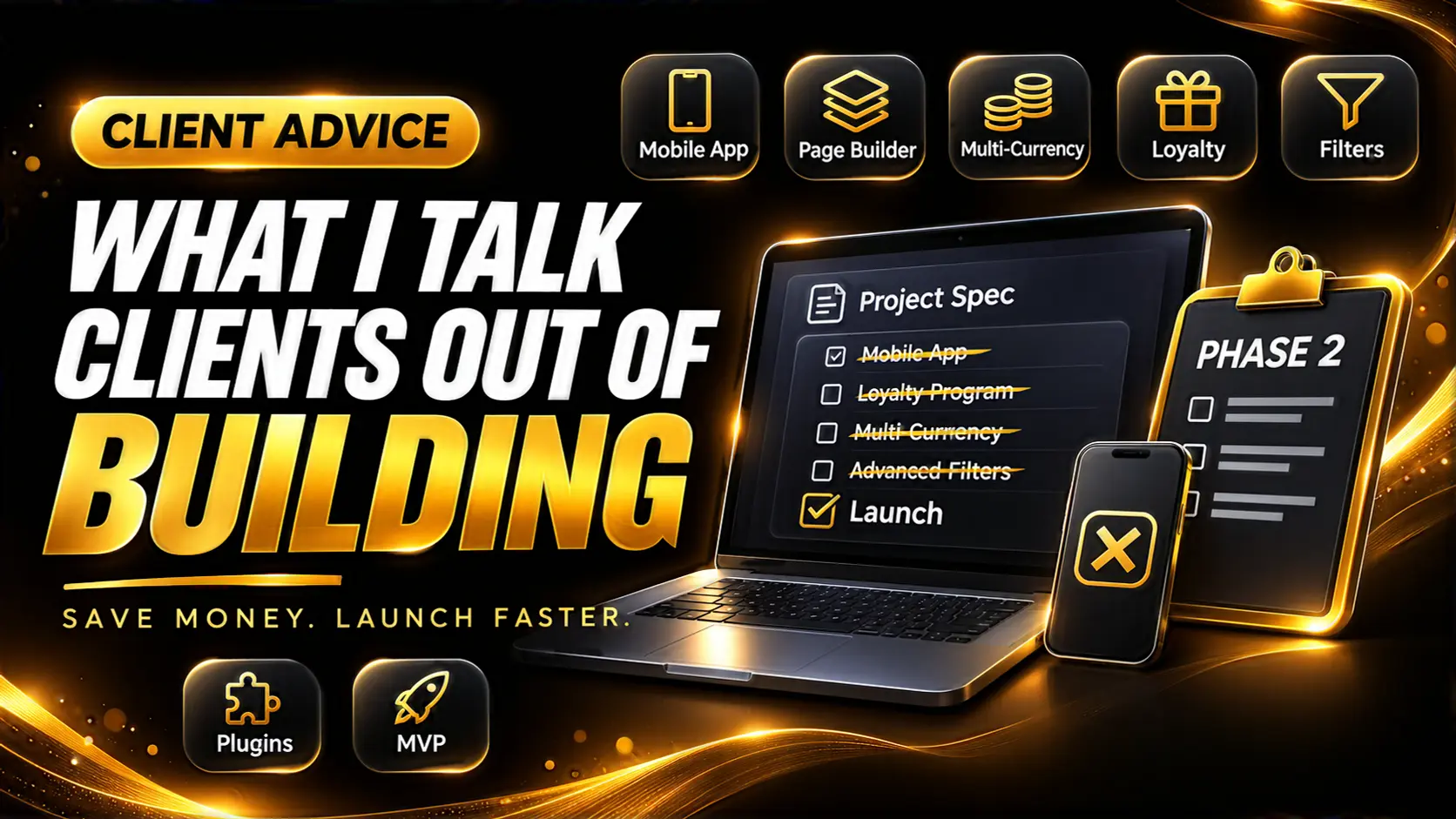
Last spring a client sent me a 14-page spec for a furniture marketplace. Vendor app for iOS and Android. A points and rewards system. Live chat with a chatbot. Three languages, four currencies. A custom page builder so the marketing person could design landing pages. And somewhere on page 11, almost as an afterthought: "vendors can list products and customers can buy them."
They had no vendors signed up yet. Not one.
We had a long call. By the end of it the build was about a third of the size, launched in seven weeks instead of six months, and cost them a lot less. They weren't annoyed. They were relieved. Someone had finally told them which parts actually mattered for day one.
I posted a short line about this on X this week: a good developer tells you what NOT to build. A few people asked what that looks like in practice, so here it is.
Why Most Developers Won't Say It
Honestly? Because every feature is billable. If you ask for a loyalty system, a developer who charges by the hour or by the feature has no real reason to talk you out of it. You asked, they build, everyone's happy until the invoice and the maintenance bills arrive.
There's also a fear thing. Saying "you don't need this" can sound like you can't do it, or like you're being lazy. So people just nod and quote.
I've done it myself early on. Built a whole custom reporting dashboard for a client who, it turned out, opened it twice. Both times to show their accountant. A CSV export would have done the job. That one stuck with me.
Things I Regularly Talk Clients Out Of
Not forever. Just not yet. Here's what comes up most often.
1. A Native Mobile App at Launch
This is the big one, especially on marketplaces. A native app means two codebases, app store reviews, push notification setup, and every change shipped twice. For a store that doesn't have regular customers yet, that's a lot of money spent on people who don't exist.
What I suggest instead: a fast, properly responsive site. Most of your traffic will be on phones anyway, and a good mobile site gets you 90% of the way. If people keep coming back and asking for an app in a year, great. Now you know it's worth building, and you know what it should do.
2. A Custom Page Builder or Admin Panel
"Our team needs to edit everything without a developer." Fair. But when I ask how often the homepage actually changes, the answer is usually twice a year. Maybe a seasonal banner.
WordPress already has an editor. Add a few well-made blocks or ACF fields for the bits that really change, and you're done. A fully custom builder is weeks of work that someone then has to maintain through every WordPress update.
3. Multi-Language and Multi-Currency for "Maybe Later" Markets
If you're selling in the UK today and thinking about Germany "at some point", don't build for Germany now. Translations need to be kept up to date, currency switching breaks caching in fun ways, and tax rules change per country.
Launch in one market. Get it working. Adding a second language to a WooCommerce store later is very doable, and by then you'll know whether German customers actually want your stuff.
4. A Points, Rewards or Loyalty System
Loyalty systems reward repeat customers. If you don't have repeat customers yet, you're building a reward for nobody. I usually suggest a simple discount code in the order confirmation email instead. "10% off your next order." Ten minutes of setup, and it tells you if people come back.
5. A Marketplace Built From Scratch
Some people come to me wanting a fully custom marketplace because they've read that plugins are "limiting." Sometimes that's true. But for most new marketplaces, Dokan with a bit of custom code covers nearly everything, at a fraction of the cost. I wrote about when Dokan really isn't enough, and the honest answer is: later than most people think. The numbers are in my post on what a multi-vendor marketplace really costs.
6. Fourteen Filters for Forty Products
Price, colour, size, material, brand, rating, stock, a slider for width, a slider for height. On a shop with forty products. Each filter adds database queries and slows the shop page down, and customers just scroll anyway when there are only forty things to look at. Two or three good filters, or even just good categories, usually do more.
7. Another Plugin for Something Small
A plugin to change one label. A plugin to hide one field. Each one is fine on its own, but they add up. I covered this in do you really need that WordPress plugin: often ten lines of code does the same thing with nothing extra to update.
The Three Questions I Ask Before Building Anything
When a feature request comes in, I try to get answers to these before I quote:
- Who uses it, and how often? If the honest answer is "an admin, once a month," it probably doesn't need a custom interface.
- What happens if we don't build it? If the answer is "someone does it by hand for ten minutes a week," that's often fine for the first few months.
- Will we know more in three months? If yes, wait. Real usage data beats guessing every time.
If a feature passes all three, I build it, and I build it properly. This isn't about doing less work. It's about doing the right work first.
"Not Now" Is Not "No"
I never just cross things off. Everything I talk a client out of goes into a "phase 2" list in the project doc, with a rough cost next to it. That way nothing is lost, the client can see I'm not dodging anything, and after launch we look at the list together with actual data.
The funny part: about half of that list never gets built. Not because there's no budget, but because once the site is live, the client realises they don't need it. The furniture marketplace from earlier? Two years in, still no native app. Their mobile site converts fine.
When I'm Wrong
Sometimes the client knows something I don't. A wholesaler once insisted on a bulk order form from day one. I pushed back a bit, thinking a normal product page would do. They explained their buyers order 80 lines at a time from a printed catalogue, and clicking through 80 product pages was a non-starter. They were right. We built the form first.
So it's a conversation, not a lecture. My job is to ask the awkward questions and give an honest opinion. The decision is still yours.
Final Thoughts
The cheapest feature is the one you didn't build. Less code means fewer bugs, faster pages, smaller update headaches and a launch that happens this season instead of next year. If your developer agrees with every single thing on your list, that's worth noticing.
If you've got a project spec and you're not sure what's essential, send it over. I'll go through it and tell you honestly what I'd build first, what can wait, and what you can probably skip. You can see what I work on in my services, or just get in touch.